
Thames Bridge Work
Specialist marine support for Thames bridge work
Livett’s provides the marine support behind Thames bridge work: stable platforms for MEWPs, flat top pontoons and barges for delivering equipment, scaffolding support, safety boats, and practical guidance on permissions and River Works Licences.
For decades we have supported bridge inspections, surveys, repairs, refurbishment and maintenance throughout the River Thames. We are licensed by the Port of London Authority (PLA) and fully insured.
Whether you are a bridge owner, principal contractor or engineering consultant, we can help you plan, access and deliver work on, under and around Thames bridges safely and efficiently, using our own vessels and crew.
We're trusted by


Bridge work we support on the River Thames
Livett’s supports every stage of bridge work on the tidal Thames, from the first inspection through to major refurbishment.
We support work on road, rail, pedestrian, historic, lifting and swing bridges, and we have worked alongside principal contractors, engineering consultants, bridge owners and their delivery partners.
Bridge inspections and surveys
Close inspection of arches, soffits, girders, bearings and abutments needs safe, stable access over water, often with strong tides and limited headroom to manage. Our work platforms carry MEWPs into position beneath the structure and, with bespoke mooring arrangements where needed, hold them steady at all states of tide. Our safety boats provide cover for inspection teams, including those working at height or by abseil.
Bridge maintenance and repainting
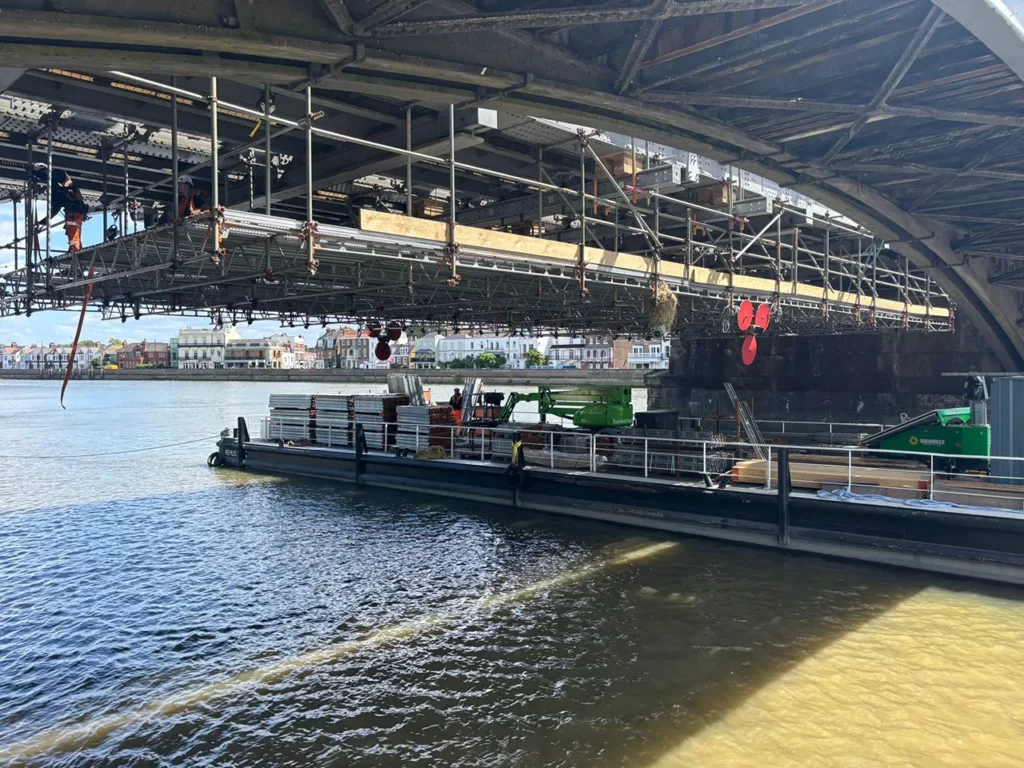
Regular repainting protects Thames bridges from corrosion and helps ensure their safety and longevity. At Cannon Street Railway Bridge, our work platform Scheldemond I gave the painting team stable access to the underside of every arch, with two MEWPs on deck, while the works were carried out at night so the bridge could stay in daily use.
Bridge repairs and strengthening
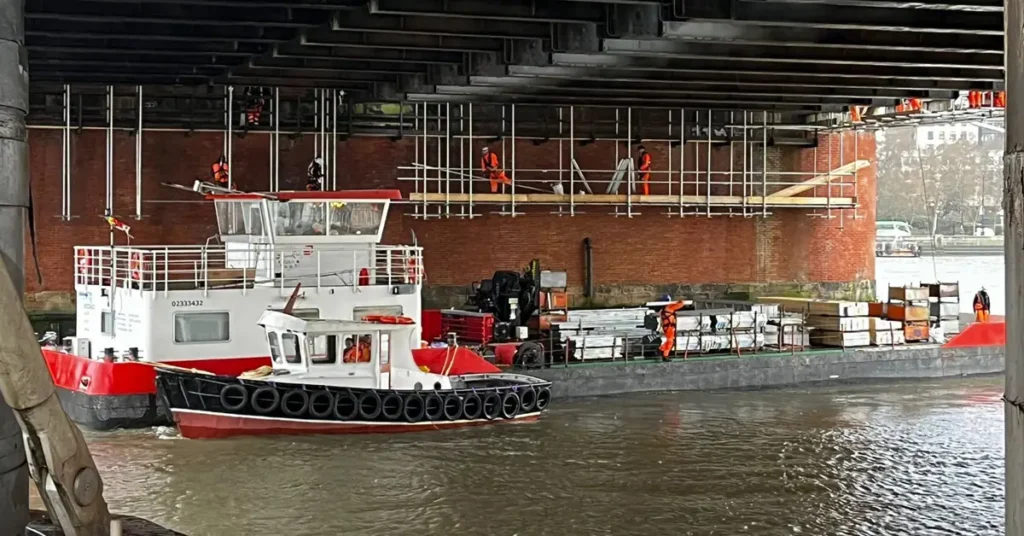
Replacing or strengthening structural components over a live river calls for heavy lifting, precise timing and careful tidal planning. During a nine-day blockade at Barnes Bridge, our barge Remus carried scaffold, supported a MEWP and delivered six new steel beams.
Bridge refurbishment and reconstruction
Major programmes can run for years and need a marine presence that is planned, consistent and safe. We were principal marine contractors for the reconstruction of Blackfriars Rail Bridge, as well as the refurbishment of Hungerford Bridge.
Other related bridge work
We also support pier and abutment works, temporary mooring systems, site accommodation and storage on the water, the delivery of materials and removal of waste by river, and diving operations from our work platforms.
Scheldemond I: our go-to work platform for Thames bridge work
Scheldemond I is one of the most versatile work platforms operating on the River Thames, and she has been central to our bridge work since joining the fleet in 2015.
This 32.5m self-propelled platform combines a crane with ample deck capacity, so she can carry MEWPs to site, transfer them into position and act as a stable base for them while teams work beneath a bridge.
Why Scheldemond I suits bridge work
- Kennis R50 mobile crane on deck with 17m lifting capacity at 2.5 tonnes
- 80-tonne deck load capacity
- Two 17m hydraulic spud legs for stable positioning
- Connects seamlessly to her extension pontoon, Scheldemond II, for even more positional flexibility
- Power, workshop and living facilities on board
- Flexible loading with roll-on/roll-off capability

How Livett’s supports Thames bridge work
We bring the vessels, crews and planning support together, so a single team can coordinate the marine side of your bridge project.
Work platforms for MEWPs
Mobile elevating work platforms (MEWPs) are one of the safest and most efficient ways to reach the underside of a bridge, but they need a stable base. We provide work platforms that can carry MEWPs, transfer them into position and act as a base for them throughout the works.
Flat top pontoons and barges for delivering equipment
Delivering equipment, plant and materials by river puts the load directly at the point of work and takes lorries off London’s roads. Our flat top pontoons and barges can carry scaffold, steel, plant, storage and site accommodation, and take waste away again.
Scaffolding support
Many bridge projects need access scaffolding above or beneath the structure. Our barges deliver scaffold to site, our crane-equipped platforms help position it, and our safety boats work alongside scaffolding crews.
Safety boats
Every bridge project on the tidal Thames needs dependable on-water safety cover. Our PLA-licensed safety boats are shallow drafted with low air drafts, so they suit work in and around bridge abutments, whether supervising abseilers or working around scaffolding. Our crews are trained to the latest STCW standards and attend regular first aid refresher courses.
Permissions and River Works Licences
Work in, over or under the tidal Thames generally needs a River Works Licence from the Port of London Authority (PLA), and projects often involve several stakeholders. We guide you through the process of securing the necessary permissions and licences, and we can prepare the marine documents that support them, such as passage plans and risk assessments that meet PLA requirements.
Our Thames bridge work experience
For decades Livett’s has supported the maintenance, repair and renewal of London’s bridges. These recent projects show how our vessels, crews and planning come together on site.

Barnes Bridge maintenance and strengthening
We supported maintenance and strengthening works on the Grade II listed Barnes Bridge for Southern Renewals Enterprise and VolkerFitzpatrick. The works were delivered safely and ahead of schedule.
Hungerford Bridge refurbishment
Livett’s was appointed principal marine contractor for the refurbishment of Hungerford Bridge, working with VolkerFitzpatrick’s Southern Renewals Enterprise team for Network Rail. We provided all marine support, including 24/7 safety boat cover, work platform and barges.

Cannon Street Railway Bridge repainting
We supported BAM Nuttall and Network Rail in repainting the underside of every arch of Cannon Street Railway Bridge. The work was carried out nightly over 12 weeks and finished on schedule with no safety incidents.

Blackfriars Rail Bridge reconstruction
We were principal marine contractor for Balfour Beatty on the reconstruction of Blackfriars Rail Bridge, maintaining a 24/7 marine presence for more than three years. We provided and crewed crane barges, tugs, multicats and safety boats, and designed bespoke mooring systems that kept the arches closed while barges worked beneath them at all states of tide.
Why choose Livett’s for Thames bridge work
Decades of Thames experience
We have owned and operated vessels on the River Thames for over 40 years, and have supported the renewal of some of London’s most important bridges in that time.
PLA licensed and fully insured
Our vessels are licensed by the Port of London Authority, and we are fully insured.
A complete fleet from one operator
Work platforms, flat top pontoons, barges, tugs, safety boats and workboats, all supplied and crewed by Livett’s.
Trained crews with local knowledge
Our marine crews are trained to the latest STCW standards, attend regular first aid refresher courses, and know the tidal Thames inside out.
Safety first
Safety is the number one priority in everything we do.
Experience of tight programmes
From time-limited blockades to night-time working and 24/7 cover, we plan around narrow tidal windows and demanding programmes.
Cleaner, quieter delivery
Moving equipment and waste by river is more efficient than road transport and helps reduce road traffic and emissions in central London.

Planning bridge work on the Thames
Every bridge is different, but most projects follow a similar path. The earlier we are involved, the more we can help.
1. Tell us about the bridge and the work
Share the location, type of work, programme and access needs. Our planning and consultancy service draws on our local knowledge to advise on what can and cannot be done.
2. Review the site and the tide
We consider tidal windows, headroom, mooring options and river traffic around the bridge.
3. Choose the right vessels
We recommend the best combination of work platform, flat top pontoon or barge, tug and safety boat for the job.
4. Secure permissions and licences
We guide you through the River Works Licence and PLA permissions process, and prepare the passage plans and risk assessments that support it.
5. Mobilise and deliver
Our crews and vessels deliver the marine side of the works, including 24/7 safety cover where it is needed.
6. Coordinate throughout
We work closely with your team, the PLA and other stakeholders so that marine movements stay safe, planned and well communicated.
Thames bridge work FAQs
What bridge work can Livett’s support on the River Thames?
We support bridge inspections, surveys, maintenance, repainting, repairs, strengthening, refurbishment and reconstruction on the tidal Thames. Our support includes work platforms for MEWPs, flat top pontoons and barges for delivering equipment, scaffolding support, safety boats, and guidance through the permissions and River Works Licence process.
Can you provide platforms for MEWPs for bridge inspections and surveys?
Yes. Our work platform Scheldemond I has a crane and ample deck capacity, so she can transfer MEWPs into position and act as a base for them. We also own a diverse fleet of barges and pontoons capable of moving MEWPs where needed.
Which types of bridge do you work on?
We support work on road, rail, pedestrian, historic, lifting and swing bridges across the tidal Thames. We have worked with principal contractors, engineering consultants, bridge owners and their delivery partners. See our marine civil engineering page for more.
Do I need a River Works Licence for bridge work on the Thames?
Work in, over or under the tidal Thames generally needs a River Works Licence from the Port of London Authority (PLA). What is required depends on the work, so it is worth speaking to us early. We guide you through the process of securing the necessary permissions and licences, and can help with supporting documents such as passage plans and risk assessments.
Do you provide safety boats for bridge work?
Yes. Our PLA-licensed safety boats are shallow drafted with low air drafts, so they suit work in and around bridge abutments. We can provide cover for abseilers and scaffolding crews, and 24/7 cover where the works demand it.
Can equipment and waste be moved to and from a bridge site by river?
Yes. Our flat top pontoons and barges can deliver scaffold, steel, plant and materials to the point of work and take waste away.
Are Livett’s PLA licensed and insured?
Yes. Our vessels are licensed by the Port of London Authority and we are fully insured. See our insurance page for more information.
How early should I contact Livett’s about a bridge project?
As early as you can, ideally at the planning stage. Early advice on tidal windows, vessel choice and the River Works Licence process helps you set a realistic programme. Contact us today to start the conversation.

Planning bridge work on the River Thames?
Talk to Livett’s about your requirements and our team will help you find the right marine solution.
We are happy to advise on the best approach based on your bridge, site, programme and operational needs, and to help you understand the practical considerations, permissions and licences early, so your project can move forward with confidence.